The Ultimate Guide: CBC Curriculum Explained in Kenya (Everything Parents & Teachers Need to Know)
It’s 7:00 PM on a Tuesday evening in a typical Kenyan household.
Mama Njeri is sitting at the dining table, surrounded by manila papers, glue, and empty plastic bottles. Her son, a Grade 4 pupil, is trying to explain a “project” about environmental conservation that is due tomorrow morning.
“Mama, teacher said we must show how to recycle,” he says. Mama Njeri sighs. Between her busy job and house chores, she feels overwhelmed by this “new” system.
If this sounds like you, you are not alone. Whether you are a parent trying to help with homework, a teacher managing 50 lesson plans, or a school owner looking to improve mean scores, the transition from 8-4-4 can be confusing.
In this comprehensive guide, we provide the CBC curriculum explained in Kenya context to help you navigate the 2-6-3-3-3 system with confidence and ease.
What is CBC? The CBC Curriculum Explained in Kenya
The Competency-Based Curriculum (CBC) is the new system of education in Kenya designed by the Kenya Institute of Curriculum Development (KICD).
Unlike the old 8-4-4 system, which focused heavily on rote memorization and passing end-of-year exams, CBC is about what a learner can do, not just what they know.
The goal is to move away from “cramming” and move toward “competence.” It focuses on identifying a child’s talents early and nurturing them through a practical, hands-on approach.
The 2-6-3-3-3 Structure
To understand the CBC curriculum explained in Kenya, you must know the stages:
-
Pre-Primary (2 years): PP1 and PP2 (Ages 4–5).
-
Primary School (6 years): Grade 1 to Grade 6.
-
Junior Secondary School (JSS) (3 years): Grade 7, 8, and 9.
-
Senior Secondary School (3 years): Grade 10, 11, and 12.
-
Higher Education (3+ years): TVETs or University.
The 7 Core Competencies of CBC
Under CBC, every lesson is designed to build seven specific skills in a learner:
-
Communication and Collaboration: Working well with others and speaking clearly.
-
Critical Thinking and Problem Solving: Not just asking “What?” but asking “Why?” and “How?”
-
Imagination and Creativity: Thinking outside the box (e.g., making toys from local materials).
-
Citizenship: Understanding their role as a Kenyan citizen.
-
Learning to Learn: Developing a lifelong desire for knowledge.
-
Self-efficacy: Building the confidence to try new things.
-
Digital Literacy: Using technology like computers and tablets for learning.
Practical Examples of CBC in the Kenyan Context
How does this look in a real Kenyan classroom?
-
Agriculture: Instead of just drawing a hoe, students might create a “kitchen garden” using discarded plastic containers to plant sukuma wiki.
-
Creative Arts: Learners might use local clay or old newspapers to create sculptures, helping them understand texture and recycling.
-
Home Science: Students are taught basic life skills, such as how to clean their own shoes or how to safely prepare a fruit salad.
This practical approach ensures that even if a student doesn’t go to a traditional university, they have “handwork” skills they can use to survive and thrive.
Step-by-Step: How Assessment Works in CBC
One of the biggest changes in the CBC curriculum explained in Kenya is how students are graded. We no longer have the high-pressure KCPE exam at the end of Class 8.
1. Formative Assessment (Ongoing)
Teachers track progress daily. They use rubrics like:
-
Exceeding Expectations: The learner did better than required.
-
Meeting Expectations: The learner did exactly what was required.
-
Approaching Expectations: The learner is almost there but needs a little help.
-
Below Expectations: The learner needs significant support.
2. School-Based Assessments (SBA)
In Grades 4, 5, and 6, students sit for internal assessments that are sent to the Kenya National Examinations Council (KNEC). These marks account for 60% of their final score.
3. Summative Assessment (KPSEA)
At the end of Grade 6, learners sit for the Kenya Primary School Education Assessment (KPSEA). This accounts for the remaining 40%. The results are used to monitor progress as they transition to Junior Secondary School (JSS).
Common Mistakes Parents and Teachers Make
Even with the CBC curriculum explained in Kenya, many stakeholders fall into these traps:
-
Doing the work for the child: Parents often complete projects for their kids to ensure they get “Exceeding Expectations.” This defeats the purpose of the child learning the skill.
-
Viewing CBC as “too expensive”: While some materials are needed, CBC encourages using “locally available resources.” You don’t always need to buy—you can recycle!
-
Resisting Technology: Some teachers and parents still shy away from digital tools. In the modern world, digital literacy is no longer optional; it is a core competency.
Comparison Table: Traditional 8-4-4 vs. CBC with AI Support
| Feature | Traditional 8-4-4 System | CBC + TutorBot AI Support |
| Focus | Exams and Memorization | Skills and Competencies |
| Teacher Role | Primary source of knowledge | Facilitator and Guide |
| Homework | Repetitive writing | Practical projects & AI-guided Research |
| Feedback | Yearly report cards | Real-time digital progress tracking |
| Pace | One size fits all | Personalized learning paths |
| Resources | Textbooks only | Digital content, AI tutors, & Local materials |
🚀 How TutorBot AI Makes This Easier
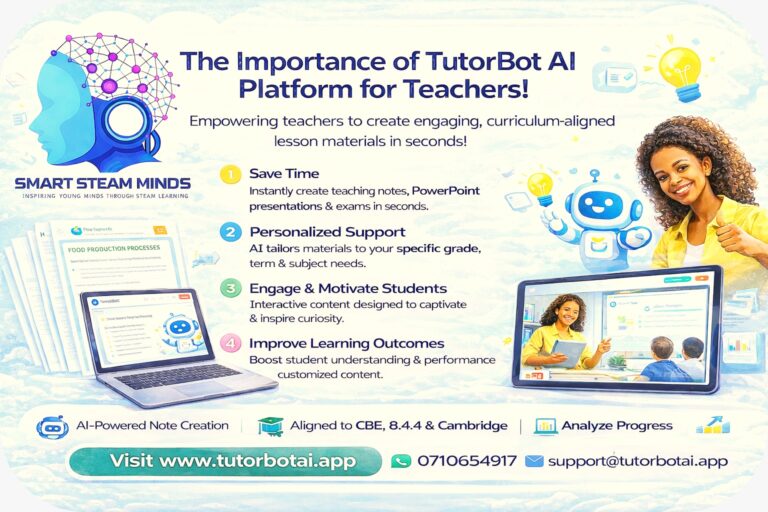
The biggest challenge with the CBC curriculum in Kenya is the workload. Teachers are tired, and parents are confused. This is where TutorBot AI changes the game.
TutorBot AI is Kenya’s leading AI-powered educational platform designed to align perfectly with the KICD curriculum requirements.
For Teachers: Reduce Your Workload
-
Auto-Generate Lesson Plans: Stop spending hours writing lesson plans. TutorBot AI generates CBC-compliant lesson plans in seconds.
-
Creative Project Ideas: Get instant suggestions for CBC projects using locally available materials.
-
Assessment Tools: Easily track which learners are “Meeting Expectations” and which ones need more help.
For Parents: End the Homework Stress
-
24/7 AI Tutoring: If your child is stuck on a math “strand” or a science “sub-strand” at 8 PM, TutorBot AI acts as a personal tutor to explain concepts in simple English.
-
Performance Dashboards: See exactly where your child is struggling without waiting for the end-of-term report.
-
Safe Learning: No more unregulated internet searches. TutorBot provides a safe, AI-driven environment for research.
For Schools: Improve Mean Scores
-
Standardized Learning: Ensure every teacher in your school is delivering high-quality, CBC-aligned content.
-
Future-Ready Students: By using TutorBot AI, your students gain the “Digital Literacy” competency naturally, giving them an edge over other schools.
FAQ: Frequently Asked Questions about CBC
1. What is the difference between 8-4-4 and CBC?
The main difference is that 8-4-4 was content-based (what you know), while CBC is competency-based (what you can do). 8-4-4 relied on one big exam, while CBC uses continuous assessment.
2. Is CBC expensive for parents?
It can be if you buy everything. However, KICD encourages the use of locally available materials. Tools like TutorBot AI also help parents find low-cost ways to complete projects.
3. What happens after Grade 6?
Learners transition to Junior Secondary School (JSS) for Grades 7, 8, and 9. Here, they explore different subjects to help them choose a “pathway” in Senior Secondary (Arts, STEM, or Sports).
4. How can I help my child with CBC if I didn’t study it?
You don’t need to be an expert. Your role is to facilitate. Use digital tools like TutorBot AI to get simple explanations for topics you don’t understand.
5. Does CBC prepare students for university?
Yes. In fact, it prepares them better by teaching them critical thinking and research skills early, which are essential for university success.
Conclusion: Embracing the Future of Kenyan Education
The CBC curriculum explained in Kenya is more than just a change in subjects; it is a change in how we prepare our children for the future. While the transition may feel bumpy, the focus on practical skills and digital literacy will create a more capable generation of Kenyans.
However, you don’t have to do it alone. Whether you are a teacher struggling with 40 lesson plans or a parent tired of “manila paper stress,” technology is your best friend.
TutorBot AI is built specifically for the Kenyan context. It takes the “work” out of coursework and the “stress” out of assessments. It is the bridge between the old way of learning and the future of Kenyan excellence.
Don’t let your child or your school fall behind. Join thousands of Kenyan educators and parents who are using AI to make CBC simple, fun, and highly effective.
👉 Ready to transform your learning experience?
Start Learning Free Today at TutorBot AI
Empowering Kenyan learners, one competency at a time!